



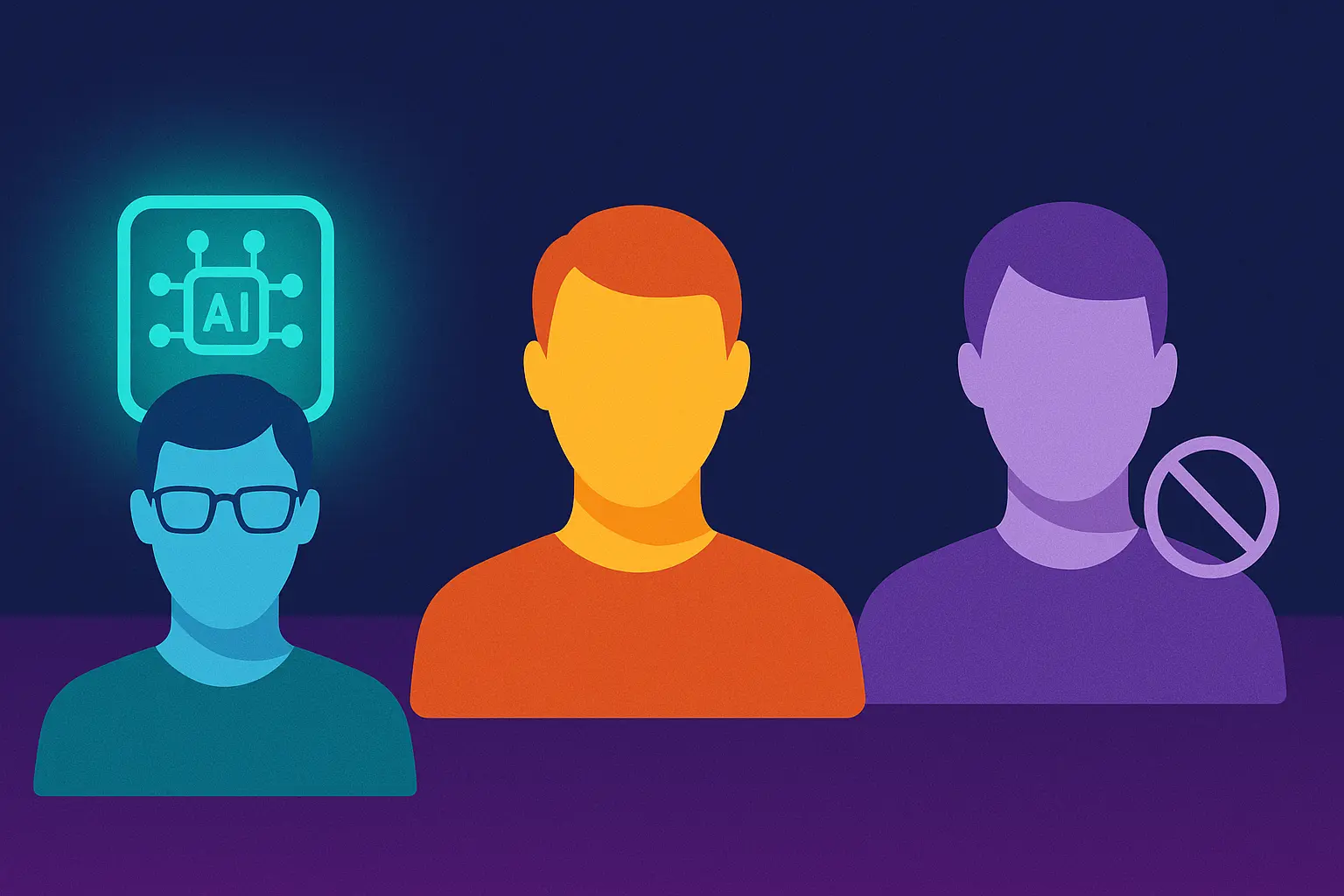
There's a quiet shift happening in software development – one that divides developers into three distinct categories:
- Developers who use AI and let everyone know it.
- Developers who use AI but don't talk about it.
- Developers who refuse to use AI at all.
We're witnessing a new stratification of the engineering world. This isn't about seniority, specialization, or even tech stacks – it's about mindset. Let's unpack each of these categories to understand where the industry is headed and where you might stand.
1. The Open AI Advocates
These developers have fully embraced AI-assisted development. They see AI not as a threat, but as a superpower – something that enhances their productivity, creativity, and ability to solve complex problems faster.
They openly share tips about how to use ChatGPT for debugging, GitHub Copilot for code generation, and Claude or Perplexity for research. They understand that these tools don't replace developers but augment them. Their goal? To build smarter, ship faster, and learn constantly.
Common traits of this group:- They're skilled in prompt engineering.
- They experiment with Agentic AI development and workflow automation.
- They understand the mechanics of LLMs, Retrieval-Augmented Generation (RAG), vector databases, and other modern AI paradigms.
- They advocate for responsible AI use within their teams and organizations.
These developers are ahead of the curve. In many ways, they're not just using AI – they're shaping how it will be used in development workflows. Personally, I admire this group for their transparency and willingness to experiment and share openly.
2. The Silent AI Users
Then there's the second group – the silent adopters.
They are using AI behind the scenes but don't advertise it. Maybe they're still exploring, not fully confident in the outcomes. Maybe they feel it's not yet accepted in their workplace. Or perhaps, they fear being judged for relying on AI, thinking it makes them appear less competent.
In some cases, they're constrained by external factors:
- Their team doesn't use AI, so they keep quiet to avoid friction.
- Their company lacks a clear policy on AI tools.
- Their client or product owner prohibits AI, fearing copyright or security risks.
This creates a risky environment. Without company-sanctioned tools, developers might turn to free versions of ChatGPT or Copilot, inadvertently exposing sensitive code or proprietary logic.
"Shadow AI" use is becoming the new shadow IT.
Why this is dangerous:
- Security risks: Free AI tools may store and learn from input data.
- Lack of governance: Developers may not understand the terms of use.
- Inconsistent results: Using AI without best practices can cause errors or inefficiencies.
I strongly encourage companies to recognize this silent use and respond proactively. Offer enterprise-grade AI tools with proper configurations. Educate developers on secure usage. Foster an environment where using AI isn't taboo – it's encouraged, guided, and ethical.
And to the developers in this group: I strongly encourage you to speak up. You don't have to shout it from the rooftops – but start a quiet conversation. Talk to your team lead. Ask about policies. Share how AI is helping you. That small step can spread organically.
3. The AI Resistors
Finally, we have those who reject AI entirely.
To be fair, some of their concerns are valid. They believe coding should remain a human-centered craft. That relying on AI is a shortcut, and shortcuts compromise quality. They might fear job replacement or simply feel overwhelmed by how fast AI is evolving.
But the refusal to adapt can have consequences.
In a landscape where companies are optimizing for speed, cost, and innovation, developers who ignore AI risk being left behind. The market will increasingly demand professionals who can work with AI – not just around it.
This doesn't mean everyone needs to become an AI engineer. But understanding how to safely and effectively integrate AI tools into your workflow is quickly becoming a baseline skill.
"You don't have to love AI – but you do need to learn how to use it."
Why this mindset needs to shift:
- The tools aren't going away.
- Clients and companies expect faster delivery.
- AI is becoming integrated in IDEs, DevOps pipelines, and documentation tools.
Ignoring AI doesn't preserve purity – it limits potential.
I think developers in this group should start small. Try AI on a side project. Use it for documentation. Let curiosity guide you instead of fear. The world is changing fast, and I believe those who adapt – even gradually – will be the ones who thrive.
A Call to Developers
So where do you stand?
Are you embracing AI, quietly experimenting, or resisting the wave? Regardless of your stance today, the trend is clear: AI isn't a novelty – it's a foundational shift in how software is built.
And just like every major evolution in tech (think cloud, mobile, open-source), those who adapt early tend to benefit the most.
Here's what you can do:- If you're an advocate, mentor others. Share your prompts. Write about your workflows.
- If you're a silent adopter, speak up. Push for policies. Educate your team.
- If you're a resistor, stay curious. Start small. Try AI on a side project.
The future isn't AI vs developers – it's developers who use AI vs those who don't.
So the question isn't just What type of developer are you? – it's What type are you becoming?